Called to Write
Called to Write
Turn Writing from a Recurring
Thought into a Living Practice
Turn the Desire to Write into a Practice You Can Actually Sustain
4 weeks of writing — 30 minutes a day
Alongside other writers
4 weeks of writing — 30 minutes a day
Alongside other writers
Starting on June 15th
Turn Writing from a Recurring Thought into a Living Practice
4 weeks of writing
30 minutes a day
Alongside other writers
Starting on June 15th
Who is Called to Write for?
Have you been carrying the desire to write for some time, but never quite found a way to make it part of your life?
You sit down intending to write, only to find yourself circling thoughts, questioning your words, or drifting away from the page before anything has the chance to take shape.
Does writing tend to happen in occasional bursts, but rarely settle into a steady practice?
You have periods of motivation, clarity, or renewed energy that bring you back to writing — only to fade before the practice becomes stable enough to support the writing life you want.
Do you feel there are ideas, experiences, or questions inside you that could grow into something larger?
Material that could eventually grow into essays, a memoir, a book, or a body of work — if you had a writing practice capable of carrying it?
If any of these match your experience...
Then Called to Write was designed with you in mind.

Who is Called to Write for?
Have you been carrying the desire to write for some time, but never quite found a way to make it part of your life?
You sit down intending to write, only to find yourself circling thoughts, questioning your words, or drifting away from the page before anything has the chance to take shape.
Does writing tend to happen in occasional bursts, but rarely settle into a steady practice?
You have periods of motivation, clarity, or renewed energy that bring you back to writing — only to fade before the practice becomes stable enough to support the writing life you want.
Do you feel there are ideas, experiences, or questions inside you that could grow into something larger?
Material that could eventually grow into essays, a memoir, a book, or a body of work — if you had a writing practice capable of carrying it?
If any of these match your experience...
Then The Writing Room was
designed with you in mind.
Why Writing Hasn’t
Become a Practice (Yet)
If you're here, the problem is probably not that you need to care more about writing.
Most likely, you've been carrying the desire for years.
Writing may even feel tied to a version of yourself you keep meaning to meet, but who somehow keeps slipping a little further into the future.
Maybe you’ve told yourself you’ll get to it when life calms down. When you have more time. More confidence. When a better idea surfaces.
Or maybe you’ve started before.
You found some momentum. A few good days. A strong week. Enough to glimpse what a writing practice could feel like before the friction of everyday life pulled you back into familiar patterns.
People often assume that if writing hasn’t become a practice, the problem must be discipline.
But for many people who care deeply about writing, that’s not the real issue.
The deeper issue is that the blank page often arrives loaded with expectation.

We carry this romantic image of the writer struck by inspiration at 2am, entering a kind of trance, typing feverishly through the night, and somehow producing a masterpiece by sunrise.
It’s a compelling narrative.
But it leaves little room for how writing usually unfolds in ordinary life.
So we begin expecting clarity before beginning. Inspiration every time we sit down. The certainty of knowing what we want to say before the writing itself has had a chance to help us discover it.
What we tend to forget is that most meaningful writing begins with a person sitting down with thoughts that don’t yet know how to become language.
Thoughts tangled up with old memories still searching for meaning. Questions that resist immediate answers. Experiences that feel larger than your current understanding of them.
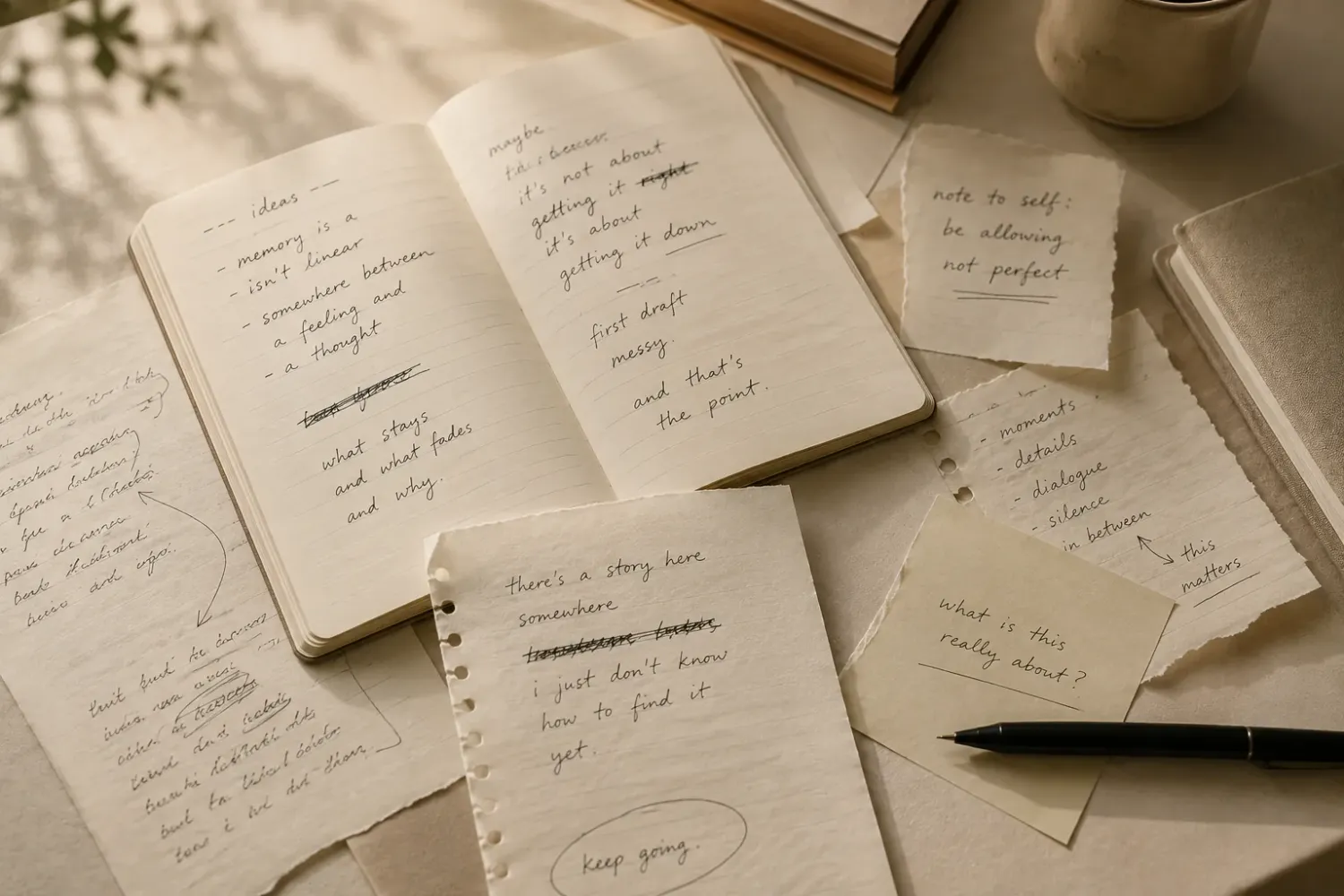
Writing often begins with material that asks to be explored before it can be explained.
If we keep waiting for clarity before allowing ourselves to begin, the practice can easily remain suspended somewhere between intention and avoidance.
You think about writing.
You read about writing.
You imagine yourself as a writer, waiting for a version of life in which the practice finally feels possible.
Yet a meaningful writing practice is rarely born from perfect conditions or dramatic acts of commitment.
It grows through learning how to come back to the page even when you don't feel fully ready.
Through a form of practice that asks for less pressure and more trust in the gradual unfolding of the work.
And through building a relationship to writing sturdy enough to support the ideas, questions, and creative work you want it to carry.
Answer the Call to Write with a Practice that Makes Writing Easier to Return To
If building a writing practice were simply a matter of discipline, most people who care deeply about writing would already have one.
As we've seen before, the challenge is often more subtle than that.
It’s about expectations that make the page feel heavier than it needs to be, and the absence of structure, support, and a writing process that fits real life.
That’s why Called to Write is designed differently.
The experience is built around five core principles that make writing easier to enter, easier to sustain, and more meaningful to return to:
Guided Orientation
You’re not left alone trying to figure out what to do next. Each step has a purpose. You’re not just performing activities blindly. Each step is designed to help you understand the process more clearly, and see why certain things help writing become a more sustainable practice.The Right Order
Building a practice isn’t only about consistency. Sequence matters. Some things become easier only after other things are in place. The experience is designed to lower the threshold gradually, rather than asking you to begin with forms of writing that ask more of you than you’re ready to give.A Sustainable Rhythm
Small enough to fit real life. Challenging enough to feel alive. Thirty minutes a day, structured to create momentum without turning writing into another source of pressure.The Right Mental Space
Different stages of writing require different mental states. Some parts ask for openness, play, and lowered expectations. Others ask for reflection and an eye for detail. The process helps you create the conditions needed for both discovery and refinement.Thoughtful Support
Writing can feel much heavier in isolation. The experience combines guidance from me with thoughtful peer support to help you gain perspective, stay connected to the work, and keep moving if you get stuck.
Here’s what those principles look like in practice across the four weeks of the experience:
4 weeks of writing
30 minutes a day
Alongside other writers
Week 1 — Sourcing
Nothing is created from zero. What we consume, and how we consume it, inevitably finds its way into our writing.
In the first week, you'll engage with a few carefully chosen texts. Through guided prompts, you'll reflect on what you read, connect it to your own experiences, and begin uncovering ideas and material already present in your life.
At the end of the week, you'll reflect on what emerged and explore those ideas further with other writers.
Week 1 — Sourcing
Nothing is created from zero. What we consume, and how we consume it, inevitably finds its way into our writing.
In the first week, you'll engage with a few carefully chosen texts. Through guided prompts, you'll reflect on what you read, connect it to your own experiences, and begin uncovering ideas and material already present in your life.
At the end of the week, you'll reflect on what emerged and explore those ideas further with other writers.
Week 2 — Ideating
We all carry ideas with us. Memories, questions, observations, and unresolved tensions.
What’s often difficult is knowing where to begin. What to follow. What to leave aside. And what actually deserves your time and attention.
In the second week, you'll move through two guided phases. First, Divergence: generating possibilities without overthinking or self-censoring. Then, Convergence: narrowing down and selecting what feels most alive and worth pursuing.
At the end of the week, you'll be invited to a 90-minute call to exchange feedback, explore what resonates with others, and gain clarity on which direction to take.
Week 3 — Writing
Writing rarely arrives all at once. Ideas become clearer through structure, exploration, revision, and time on the page.
What’s often difficult is knowing how to move from a promising idea to a finished piece without getting stuck in perfectionism, confusion, or endless rewriting.
In the third week, you'll move through a guided writing process: outlining the structure of your piece, deepening your thinking through research and reflection, drafting without self-censorship, and then editing and sharpening the piece into its final form.
Week 4 — Refining
One of the hardest parts of writing is judging your own work.
When you're too close to a piece, it becomes difficult to see what’s working, what’s unclear, what feels underdeveloped, or what deserves more attention.
In the fourth week, I’ll read your piece and give you detailed feedback on it. Other writers will also review your work and, through my guidance, offer thoughtful, constructive feedback.
Just as importantly, you'll be asked to review the work of other writers too. Learning how to read another writer’s work critically often sharpens your ability to recognize those same patterns, strengths, and blind spots in your own writing.
At the end of the week, you'll have the opportunity to join a 90-minute call with me and the other writers to deepen the conversation, expand on the feedback, and reflect together on what emerged through the process.
After Week 4 — Community
Once you've completed the 4 weeks, you'll have the core building blocks of a writing practice in place.
To help you keep the momentum, you'll also receive lifetime access to a community of writers who have gone through the same process, along with ongoing access to me inside that space.
That means you can continue sharing your writing, exchanging feedback, asking questions, and staying in conversation with people who understand what it means to build a writing practice over time.
The goal is to give you a place you can keep returning to, so your writing practice has the support to continue beyond the four weeks.
Week 2 — Ideating
We all carry ideas with us. Memories, questions, observations, and unresolved tensions.
What’s often difficult is knowing where to begin. What to follow. What to leave aside. And what actually deserves your time and attention.
In the second week, you'll move through two guided phases. First, Divergence: generating possibilities without overthinking or self-censoring. Then, Convergence: narrowing down and selecting what feels most alive and worth pursuing.
At the end of the week, you'll be invited to a 90-minute call to exchange feedback, explore what resonates with others, and gain clarity on which direction to take.
Week 3 — Writing
Writing rarely arrives all at once. Ideas become clearer through structure, exploration, revision, and time on the page.
What’s often difficult is knowing how to move from a promising idea to a finished piece without getting stuck in perfectionism, confusion, or endless rewriting.
In the third week, you'll move through a guided writing process: outlining the structure of your piece, deepening your thinking through research and reflection, drafting without self-censorship, and then editing and sharpening the piece into its final form.
Week 4 — Refining
One of the hardest parts of writing is judging your own work.
When you're too close to a piece, it becomes difficult to see what’s working, what’s unclear, what feels underdeveloped, or what deserves more attention.
In the fourth week, I’ll read your piece and give you detailed feedback on it. Other writers will also review your work and, through my guidance, offer thoughtful, constructive feedback.
Just as importantly, you'll be asked to review the work of other writers too. Learning how to read another writer’s work critically often sharpens your ability to recognize those same patterns, strengths, and blind spots in your own writing.
At the end of the week, you'll have the opportunity to join a 90-minute call with me and the other writers to deepen the conversation, expand on the feedback, and reflect together on what emerged through the process.
After Week 4 — Community
Once you've completed the 4 weeks, you'll have the core building blocks of a writing practice in place.
To help you keep the momentum, you'll also receive lifetime access to a community of writers who have gone through the same process, along with ongoing access to me inside that space.
That means you can continue sharing your writing, exchanging feedback, asking questions, and staying in conversation with people who understand what it means to build a writing practice over time.
The goal is to give you a place you can keep returning to, so your writing practice has the support to continue beyond the four weeks.
Starting on June 15th
Creator & Facilitator of Called to Write

Hi, I'm Gianni de Rezende Cara.
Half Brazilian, half Italian. So yes, I do like football and pizza.
But there’s something I like even more:
Writing.
Over the last twenty years, writing has followed me through very different worlds.
I started in Rio de Janeiro’s underground music scene, writing about DJs, events, and a creative community trying to find its identity.
Years later, I found myself co-writing books, launching podcasts, hiring writers, leading creative teams, and helping build communities that grew into annual conferences welcoming more than 1,500 people.
Looking back across those experiences, I started noticing a pattern.
The projects that endured were rarely sustained by motivation or discipline alone.
They were sustained by genuine conversations, feedback, shared purpose, people challenging ideas, and helping creative work survive long enough to find its shape.
Ironically, over the last few years, the success of my work gradually moved me into a position where I was spending less and less time writing.
More meetings. More management. Almost no time with the page.
So in 2025, I started a newsletter as a side project, simply because I wanted writing back in my life again.
I didn’t have a grand strategy for it.
I just wanted to reconnect with the practice.
About a year into the newsletter — 44 essays and nearly 3,000 readers later — I found myself returning to the same lesson I had encountered years earlier:
Writing becomes easier to sustain when there’s a thoughtful community around it.
That realization became the seed for Called to Write.
I couldn’t find a place where thoughtful writers could keep exploring what matters to them while being supported by structure, feedback, and other people committed to the practice.
So I built one.
Words from Creatives I've Worked With

I found Gianni's insights and feedback on the writing I submitted to be consistently on point and delivered in a humble and respectful manner. And if that's not enough, he is also a master of getting stuff done.
Helena Bouchez
Principal at Executive Words
Gianni is one of the most insightful writers I know. Every time we speak I leave full of ideas. He goes much deeper than just chasing attention - he knows how to spark insightful ideas. In today’s world, that’s an incredible skill (and he’s great at teaching it too!)
Kieran Drew
Writer & Entrepreneur
I always struggled to reconcile two energies inside me: the artist and the entrepreneur. But after working with Gianni, I began to see that the two weren’t in conflict. Creativity could have structure. Writing could be both expressive and intentional. For the first time, the artist and the entrepreneur in me stopped pulling in opposite directions and started working together.
Arnaldo Neto
Founder of Living on Purpose
Gianni does what the best producers and directors do: he doesn't mold you into something, he finds what's already distinct in you and pulls it to its full potential. Plenty of people understand great storytelling; few can teach it. Gianni's one of them.
Xavier Cicero
Creative Director at Home Service Freedom
I found Gianni's insights and feedback on the writing I submitted to be consistently on point and delivered in a humble and respectful manner. And if that's not enough, he is also a master of getting stuff done.
Helena Bouchez
Principal at Executive Words

Gianni is one of the most insightful writers I know. Every time we speak I leave full of ideas. He goes much deeper than just chasing attention - he knows how to spark insightful ideas. In today’s world, that’s an incredible skill (and he’s great at teaching it too!)
Kieran Drew
Writer & Entrepreneur
I always struggled to reconcile two energies inside me: the artist and the entrepreneur. But after working with Gianni, I began to see that the two weren’t in conflict. Creativity could have structure. Writing could be both expressive and intentional. For the first time, the artist and the entrepreneur in me stopped pulling in opposite directions and started working together.
Arnaldo Neto
Founder of Living On Purpose

Gianni does what the best producers and directors do: he doesn't mold you into something, he finds what's already distinct in you and pulls it to its full potential. Plenty of people understand great storytelling; few can teach it. Gianni's one of them.
Xavier Cicero
Creative Director at Home Service Freedom
Starting on June 15th
A Few Practical Questions
To make it easier for people across different time zones to join, I’ll run each live session twice on the same day.
Weeks 2 & 4
Call 1 — Friday, 11:00 am CEST
Los Angeles: Friday, 02:00 am PDT
Toronto: Friday, 5:00 am EDT
Brazil (São Paulo): Friday, 6:00 am BRT
Australia (Perth): Friday, 5:00 pm AWST
Australia (Sydney / Melbourne): Friday, 8:00 pm AEST
Call 2 — Friday, 5:00 pm CEST
Los Angeles: Friday, 8:00 am PDT
Toronto: Friday, 11:00 am EDT
Brazil (São Paulo): Friday, 12:00 pm BRT
Australia (Perth): Friday, 11:00 pm AWST
Australia (Sydney / Melbourne): Saturday, 2:00 am AEST
Timezone note: Time zone changes due to daylight saving can make some of the converted times above slightly inaccurate depending on where you live. If there’s any doubt, please take CEST (my timezone) as the definitive reference point and convert from there.
The daily activities will take place inside Circle, where you'll have access to me and the other writers throughout the experience.
Circle also has its own mobile app, so if you prefer, you can access Called to Write directly from your phone.
The live calls will happen on Zoom, simply because it’s familiar to most people and easy to use.
The practice will revolve around two broad directions: non-fiction writing and short stories.
That said, the goal is not to fit into a specific format. The aim is to help you develop a way of writing that allows you to explore your thoughts with more depth and clarity.
Whether you're reflecting on personal experiences, exploring ideas, working through questions that matter to you, or experimenting with fiction, the practice is designed to support that process.
The investment is a one-time payment of €97.
If you miss a day or a live session, you can simply pick it back up without feeling like you’ve failed the program.
The goal is not perfection. It’s to help you build a writing practice that can survive real life.
And if something significant happens and you need to step away entirely, just message me. I’ll welcome you into a future cohort, free of charge, when the timing works better for you.
For many people, the problem is not a lack of time. It’s that writing hasn’t yet earned a protected place in their lives.
You know the drill. Work grows more demanding, life fills with small urgencies competing for attention, and writing keeps getting pushed to tomorrow.
That’s part of why this experience is designed around a small, sustainable daily practice: only 30 minutes a day. Because a smaller practice is easier to protect, return to, and sustain in the middle of a full life.
Starting on June 15th
Called to Write is created and led by Gianni Cara.
Questions before joining?
Email: gianni@write2lead.com
You can also find me here:
• Substack
Based in The Hague, The Netherlands
Privacy Policy | Terms & Conditions
Called to Write is created and led by Gianni Cara.
Questions before joining?
Email: gianni@write2lead.com
You can also find me here:
Based in The Hague, The Netherlands
Reclaim the Power of Your Words:
Enter your email below—and let’s break free from the algorithm, reclaim the power of our voice, and build something that resonates—long after the scroll fades.